When A School Gets It (At Least A Little) Right

It’s so rare that I come across an article where I find myself nodding enthusiastically along with school administrators, that I wanted to highlight this piece from the SUNY Oswego student newspaper. The story reports that although two rapes were reported on campus in February of this year, neither student chose to take criminal action. The Assistant Dean of Students for Judicial Affairs in this story is frankly rocking my world.

She doesn’t shame victims for choosing not to report, frames reporting as important for the sake of the victim, AND highlights that students have two options for pursuing charges (emphasis mine):

“It’s a personal decision that victims make and if they decide to report at all and then decide to file criminal or judicial charges,” said Assistant Dean of Students for Judicial Affairs Lisa Evaneski in an e-mail.  “We hope that victims will report so we can assist them in getting the immediate care that they need, preserve evidence in case they later decide to press charges and get resources that will help them transition through the stages of recovery.”

She’s involved in starting a Sexual Assault Response Team that is focused on increasing reporting rates and providing more support for survivors:

“There are benefits to having a team of people who have specific training who can be on call and prepared to assist a victim after an assault,” Evaneski said.  “There are medical, emotional, and legal/judicial options to consider as well as accommodations on campus.”

But here’s the kicker: she frames a higher rate of reports as a positive!

“We may have had more people report, but that is a good thing because then we can provide services, medical care and talk to students about criminal and judicial options,” Evaneski said.

Yes, yes, yes! How refreshing is it to hear a school administrator say “it’s GOOD to have people reporting sexual assaults!” Because then the school can do IT’S JOB and support its students! What a lovely idea!

Now, that said, I of course no nothing about what the reality is at SUNY Oswego and if all of this awesome talk plays out on campus. And certainly I was extremely frustrated that I couldn’t really find a stand-alone sexual misconduct policy for the school, only this page on Date Rape which is kind of a mixed bag. (Can’t really wrap my head around “Be aware of your nonverbal messages, acknowledging the possibility of misunderstandings.”) But hopefully a SUNY Oswego student will see this and fill me in on what I’m missing by submitting whatever policy there is to the Campus Accountability Project.

Update: as provided in the comments, the Oswego policy can be found here: http://www.oswego.edu/Documents/student_handbook/handbookpdfs/093-120%20Community%2010-11.pdf. Glad I was wrong on this one!

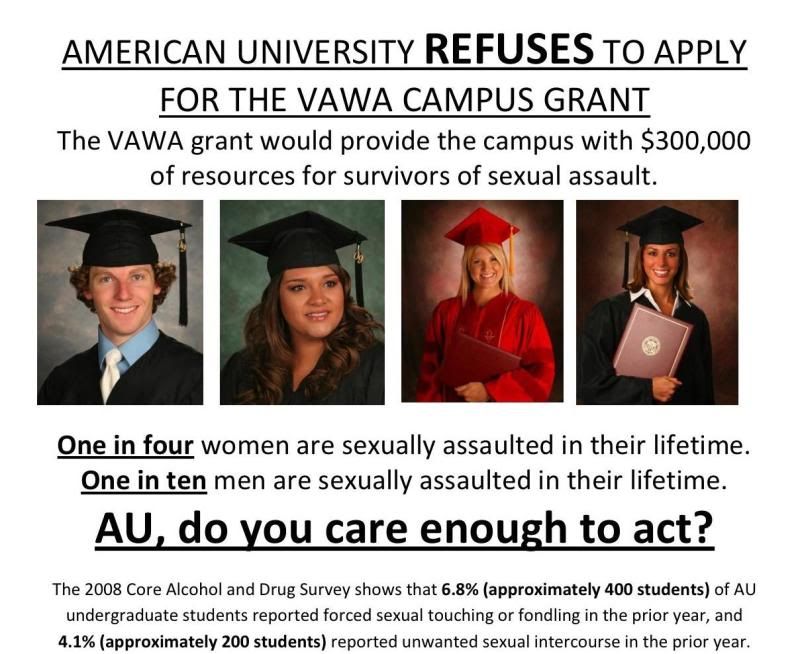
Quick Hit: American University administration refuses sexual assault campus grant

American University students are being given the run around by Vice President of Campus Life, Gail Hanson, as reported by Amanda Hess at TBD. Three days before the application deadline for a grant from the U.S. Department of Justice to fund anti-violence campaigns, Hanson asked the student grant committee to “craft an alternate solution.”

Each year, the U.S. Department of Justice shells out $300,000 grants to help colleges and universities fund initiatives to reduce violence against women on their campuses over a three-year period. Last June, a committee of American University administrators, faculty, and students set to work on drafting an application for the grant, hoping to secure funds for a full-time victims advocate, increased training of school officials, a dedicated student group to involve men in sexual assault prevention—and a “mandatory education program for all new students.”

But Hanson’s refusal of the grant is not due to any lack of concern by the students. In fact, at the beginning of the school year, the student senate voted unanimously to make sexual assault education modules mandatory in order to register for spring classes. As a condition of the grant itself, the DoJ requires the funds be allocated to programs with a “hard mandate” in order to ensure every student be engaged with and affected by the program.

So why all the resistance from Hanson?

Since news of Hanson’s derailment of the initiative, student activists have been speaking out to convince administration to pass the grant application before tomorrow’s deadline.

In a letter published in American University campus newspaper the Eagle, Undergraduate Senator Brett Atanasio boosted the campaign. Atanasio called out the administration for enforcing mandatory alcohol awareness training, but refusing to institute similar trainings around sexual assault. “The rationale behind AlcoholEdu is that alcohol is an intractable part of college life, and because of that students must be educated in order to understand how to handle alcohol and protect themselves,” Atanasio wrote. “Unfortunately, sexual assault and rape are also a part of college life, even here at American University. If American University were to receive over $300,000 to provide help and services to victims of sexual assault and violence, it could go that much farther empowering students with the knowledge they need to understand consensual sex and ways they can protect themselves from rape.

Tomorrow at 11 a.m. AU students will stage a protest for the sexual assault prevention funds that they deserve.

Pledge to Make Your Campus SAFER This Sexual Assault ACTIVISM Month

For the past ten years, April has been known as Sexual Assault Awareness Month. This year, SAFER decided we wanted to take a slightly different approach. We’re recognizing this April as Sexual Assault ACTIVISM Month, and we’re asking students and their allies to join us in pledging to take concrete steps toward holding their schools and communities accountable for preventing, reducing, and responding to sexual assault on campus. And because we know ya’ll are already busy, we want to reward your action with some awesome prizes.

Here’s how it works: Students, alumni, and other student allies like parents, faculty, and campus staff can pledge to one or multiple SAAM actions on our pledge page. These actions include:

  • Participating in the V-DAY and SAFER Campus Accountability Project
  • Creating and submitting media (video, visual, or text) that defines what accountability means to you and your campus movement (see our video below for some of our thoughts on accountability)
  • Launching a campaign for sexual assault policy reform campaign at your school
  • Spreading the word about Sexual Assault Activism Month
  • Helping us out with fundraising so we can continue to support student movements across the country
  • Telling us what kind of great work you’re already doing on your campus to fight sexual assault so we can archive your strategies and and victories to inspire future activists.

We also want you to tell us why you’re taking action and (with your consent) we’ll share those explanations along with any media submissions on our new tumblr. Once you’ve pledged, you’ll be taken to a page with more detailed ideas for how to take action this SAAM.

At the end of April, we’ll be sending everyone who pledged a brief questionnaire so you can tell us how you took action and we will enter you into a raffle (and we’ll be adding more to that prize list throughout the month). Raffle winners will be selected at random in early May. We’ll also ask you to nominate an exceptional activist/group of activists who will be eligible to win a free SAFER training when the school year kicks off next fall! (And by all means, when the time comes, nominate your own group!)

We’re kicking things off a couple of days early, so you officially have 33 days to pledge to take action this SAAM! We have this amazing vision of campus movements being born, or growing, across the country this April, and we absolutely cannot wait to hear about it. Sexual Assault ACTIVISM Month starts NOW.

Critic’s Pick: LGBTQ-Inclusive Language

After thinking about what consent means for people with disabilities, I want to explore other often marginalized identities and discuss how campus sexual assault policies use (or don’t use) lesbian, gay, bisexual, queer transgender and gender non-conforming inclusive language.

Let’s begin with some unfortunate news: I’ve searched a heck of a lot of these policies, and I have only found ONE that explicitly mentions LGBTQ people. Recently reviewing a student submission, I came across this statement in University of Akron’s policy:

Sexual misconduct and sexual assault is a serious crime that can affect men and women, whether gay, straight, transgender or bisexual.

This is good—a policy needs to be explicitly inclusive of different communities of people. University of Akron does not simply say something vague about “all members of the community” or exclude (like many other schools!) huge populations of students by only using “man” and “woman.” Where I could see Akron’s statement improving is in addressing gender non-conforming, or genderqueer, individuals. To specify, gender non-conforming refers to people who do not follow societal norms, such as dress and activities, based on their biological sex. Gender non-conforming people may present themselves as gender-free rather than clearly male or female; they may identify as transgender, gay, lesbian, bisexual or none of the above. A more inclusive alternative to Akron’s policy might be: “Sexual misconduct and sexual assault is a serious crime that can affect any individual, regardless of sexual orientation or gender identity. It can affect men, women, or gender non-conforming/genderqueer people, whether gay, straight, transgender, or bisexual.” While the wording is only slightly altered, it would have huge implications for many students. The unfortunate reality, however, is that Akron is still miles ahead of other schools in this regard—they may not offer the most inclusive language, but they are the only institution I found that mentioned the LGBTQ community at all.

When a school’s sexual assault policy does not even consider certain populations of students, what does that mean for those students who consider themselves part of these populations?

In general, sexual assault is hard to talk about. It’s already the kind of thing that makes people uncomfortable, that people want to keep quiet. Sexual assault within the LGBTQ community has received so little attention even from those whose job it is to discuss it: researchers, support services and the criminal justice system. The discourse around sexual violence is often so focused on heterosexual men and women that any person not in those categories may feel marginalized and ignored. It’s hard to wrap your head around the idea of a woman assaulting another woman or a man assaulting another man when no one ever brings it up—but that doesn’t mean it doesn’t happen. LGBTQ survivors of assault have the same basic needs as heterosexual survivors of assault, but this lack of attention serves to keep this topic even further under wraps, resulting in a lack of culturally competent support and very few resources for healing. Queer survivors have an equal right to be believed, validated, and supported to reach recovery and justice.

We live in a society with so many levels of internalized and externalized homophobia and part of understanding and changing violent behavior is acknowledging and challenging that homophobia. Although violence does exist within LGBTQ communities, their sexual orientations and gender identities are not the cause of that violence. Like all forms of sexual violence, assault within the LGBTQ community is used to assert power and maintain the status quo (specifically here, heterosexism).

There are several unique needs and problems that arise in the LGBTQ population when it comes to reporting sexual assaults. Just to name a few: fear of prejudice and victim-blaming because of societal homophobia and bias, fear of being forced to reveal their sexual orientation, fear of betraying the LGBTQ community if the perpetrator is also LGBTQ, and fear of having the experience minimized or sensationalized.

Looking at the wide range of campus sexual assault policies out there, it is shocking how few schools make explicit mention of the LGBTQ community. Even the most liberal campuses well known for having large LGBTQ populations don’t seem to directly address the issue. For all the reasons I mentioned above, it is not enough to simply use gender-neutral language.

Many schools, like College of the Holy Cross and Carleton College, limit the identities in their policies to “man” or “woman.” Although this wording recognizes same-sex assault (“by a man or woman upon a man or woman”), it does not acknowledge any gender identity outside of those norms.

Some campuses, like Macalester College and the University of Vermont, work to be inclusive of all identities in general, but do not name the LGBTQ community specifically. Tufts University provides a good example of this middle ground. Listed under the Survivor’s Rights, it says:

We will treat your case seriously regardless of your or any suspect’s sex, gender identity and expression, sexual orientation and behavior, race, ethnicity, religion, national origin, age, disability, or veteran status.

This isn’t terrible; it acknowledges the diversity of survivors of sexual assault and ensures that a case will not be unfairly minimized. However, there is something powerful about naming LGBTQ students as survivors. Especially on college campuses, LGBTQ people are often disproportionately assaulted, and therefore merit explicit acknowledgment. A study done by the Wisconsin Coalition Against Sexual Assault shows that from a sample of 412 university students, 16.9% of the subjects reported that they were lesbian, gay, or bisexual; the remainder identified themselves as heterosexual. 42.4% of the lesbian, gay, and bisexual subjects and 21.4% of the heterosexuals indicated they had been forced to have sex against their will. With this in mind, when policies explicitly include the LGBTQ community, it is validating and supportive in an active way that encourages individuals to come forward.

The majority of policies that I’ve seen fall under this last category, and while maybe it’s not the worst, there’s no good excuse for not being more explicit. The problem does not seem to be that schools are not aware of sexual violence against the LGBTQ community. In fact, many schools have fact sheets and other information about this very topic posted online to help. Check out these great resources from Illinois State University, Lewis and Clark, Harvard University, George Washington University,University of Minnesota, and University of California, Berkeley. The Office of Sexual Assault Prevention (OSAP) at Evergreen State College even states:

OSAP is committed to being a culturally competent, Queer-positive, Transgender-positive space and provides services sensitive to the unique needs of all students, staff and faculty, particularly those whom are members of groups disproportionately affected by sexual violence. OSAP collaborates with community agencies, First People’s Advising and student activities groups to provide advocacy and services relevant to each individual.

Not one of the schools listed above includes anything about LGBTQ students in its policy, however. It’s baffling that the great resources and knowledge that schools possess don’t translate into inclusive policies. The majority of policies that I’ve seen fall into the same category as Tufts with regards to inclusiveness, and while maybe it’s not the worst, there’s no excuse for not being more explicit. One or two sentences in a policy could make all the difference for many students.

Quick Hit: The Today Show is Looking for Student Survivors!

Yesterday, SAFER received a phone call from the Today Show regarding an upcoming segment on college sexual assault and the ways in which it’s frequently mishandled. It just so happens that they’re also looking for student survivors whose experiences speak to the problems that arise because of inadequate policies and procedures for dealing with sexual violence on campus. If you would like to share your story with the Today Show, let SAFER know! Eligible survivors will:

  • be located anywhere in the U.S.
  • be ready to be on film, have their first name identified, and disclose the name of the school involved. The Today Show will be contacting the school for comment and response.
  • be available to be interviewed next week.

Also, the case should be no more than five or six years old. Please email SAFER at communications@safercampus.org for more details!


NYC Quick Hit: Three Events Worth Checking Out

Times like these I wish I wasn’t going to school and working and doing SAFER, because I would totally go to these!

Saturday, March 25-27: WAM! It Yourself NYC. A weekend of women, action, and media and for so cheap! Start off with happy hour on Friday, end with a potluck on Sunday, and for $15 see a bunch of amazing speakers at Hive 55 on Saturday.

Sunday March 27, 8 pm: Comedy benefit for Planned Parenthood at the People’s Improv Theater. I like the Village Voice’s take: “The Republican attack on a woman’s right to choose will never be funnier.” Tickets: $10.00.

Wednesday March 30, 6 pm: Reproductive Health Access Panel on Young Feminists and Reproductive Choice at the Phillips Ambulatory Care Conference Center. Panelists include Jasmine Burnett, Shelby Knox, Amanda Marcotte, and Aimee Thorne-Thomsen.


Take It All Off: How Rape Culture Lets Clothing Conceal Crime

Hi SAFER family! Megan introduced herself earlier and I thought I would follow suit before delving into some ruminations…

My name is Selena and I’m SAFER’s other Co-Communications Coordinator along with Megan. I recently graduated from New York University with a bachelor’s in Media, Culture, and Communication. I currently work at a corporate public relations firm in Murray Hill where I coordinate day-to-day media relations strategies. When I’m not developing social media and digital outreach plans, I can most likely be found knitting ugly scarves, taking too many photographs, or eating endlessly.

I thought I’d take a minute to talk about clothing. When it comes to the issue of sexual assault, I am sick and tired of talking about clothing. For a while now, there has been talk of the term “Skinny Jeans Defense” that reemerged after an Australian jury voted to acquit a man of rape arguing that the victim’s tight-fitting pants could not have been removed without collaboration, and therefore, consent.

The sad truth is that variations of this “argument” have used for over a decade now and yet it is still being thrown around as an actual reason for acquittal of a rapist. How is this possible? Let’s take a look.

In the recent gang rape of an 11-year-old girl in Texas, the media has repeatedly been guilty of placing the blame on the victim. A recent article in the Huffington Post calls out the coverage not only as victim-blaming but victim-silencing:

The New York Times reported on the community’s response to the girl’s dress and appearance, implying that she asked for it. The Daily Beast focused on how this crime has divided the town of Cleveland, TX and has affected the reputation of this nice and hospitable place. A Fox News piece is centered on the difficult defense of the suspects and on the fact that they all knew the girl was 11. Another article from Fox News Houston brings to light the perspective of Quanell X, the new Black Panther Leader, who stands up for the suspects, all black males.

A few days later, the Wall Street Journal published an article by author Jennifer Moses asking mothers why they let their daughters, and pay for them to, dress like “prostitutes” with “plunging necklines, built-in push-up bras, spangles [P.S. what the hell are spangles], feathers, slits and peek-a-boos.”

Moses theorizes that mothers are funding their daughters’ mini dresses and heels because they are conflicted about their own past.

We are the first moms in history to have grown up with widely available birth control, the first who didn’t have to worry about getting knocked up. We were also the first not only to be free of old-fashioned fears about our reputations but actually pressured by our peers and the wider culture to find our true womanhood in the bedroom.

While Moses’ effort is relatively innocent in nature, it is precisely this kind of conversation that contributes to the quickly evolving but ever present rape culture in our country and abroad. She is addressing the parents who are looking to their children as reflections of themselves, and wanting to relive their glorious youth through their children. But she is also inadvertently telling existing and potential assailants that their crime is excusable in the face of dark eyeshadow and lipgloss. She bridges the gap between clothing and promiscuity with the threat of violence.

We wouldn’t dream of dropping our daughters off at college and saying: “Study hard and floss every night, honey—and for heaven’s sake, get laid!” But that’s essentially what we’re saying by allowing them to dress the way they do while they’re still living under our own roofs.

As Moses describes her own generations’ regrets and battle for clarity in the messaging surrounding female sexuality, it becomes increasingly evident that the same line of uncertainty is still not only prevalent but prevailing in today’s society. Although today’s generation of young women have been fortunate to inherit the benefits of the birth control pill, less fortunately, it has inherited the message that women are to feel guilty about having sex. And in order not to feel that guilt, ditch the Spanx and put on a turtleneck.

I wouldn’t want us to return to the age of the corset or even of the double standard, because a double standard that lets the promiscuous male off the hook while condemning his female counterpart is both stupid and destructive.

In 1999, the outrage caused by the first successful use of the “Skinny Jeans Defense” in Italy launched a global movement that is now known as Denim Day. Immediately following the disgraceful verdict,  the women in the Italian Parliament protested by wearing jeans to work. With a hop, skip and a jump, the protest spread to the California Senate and Assembly, and with that, Denim Day LA was established. By asking communities to make a statement through fashion choices, Denim Day recasts the role of clothing as means of protest against misconceptions that surround sexual assault. This year, Denim Day LA and USA is April 27, 2011.

The longer we reprimand our daughters or their makeup but do not reprimand our sons for their crude college Halloween party invitations, the longer we perpetuate the double standard, and the longer we let the clothing conceal the crime.

Tuesday Campus Link Round-Up

I came to my computer today ready to write an incensed post about how the De Anza civil trial is playing out, to find that Cara at The Curvature had me covered. Please read her post for the full update on the trial, but beware the depressing amount of victim-blaming/”slut-shaming” involved in this case.

Last year, SAFER did a training at SUNY Geneseo, where a survey of students showed that “about 15% of women and 8% of men in [the sample] were severely sexual assaulted.” I was excited to read last week about their Sexual Assault Teach-In, which included a presentation from the awesome folks at Green Dot.

The National Union of Students in Australia is undertaking a large-scale survey of college students, and has so far found that “1 in 10 female students have experienced sexual violence while in university.”

A student at San Diego State University describes her frustrating experience with campus police after being raped and beaten by her then-boyfriend. She wanted to file for a restraining order, but the campus police would not release the report to her, which included the photographs of her injuries. Here’s something you never want to read: “I was at Staples taking pictures of my bruises, doing all of this on my own, paying out of pocket.”

Jessica Valenti called out university responses to sexual violence this weekend, mentioning the Yale frat chant, and the recently released recommendations of the task force that was subsequently formed at Yale. The recommendations focus on education, but the full report can be found here.

Finally, there is an interview with Heather Corinna of Scarleteen over at Where is Your Line? I really loved her answer to the question “How do you think we, as young activists and students can best make a difference?” and wanted to share it here:

Value your own voices and experiences where they are right now and get them out there, ideally to a larger audience that just the people who you’re working with. I often hear young people who feel that there’s no point in them speaking up and out because older people won’t care or some peers won’t care. However, even for those who won’t care — and whose adultism is their problem and bias — plenty do care, and more to the point, your peers do care and they need to see and hear you to help them feel and be more empowered.

Everyone also needs all of you to speak to where you have been and where you are, rather than trying to speak from a place that isn’t yours, or is a place you’re not at yet, but think you need to be at to have authority or earn respect. Not only do you not need to be anywhere but where you are, giving your own experiences and the you-of-right-now the weight they deserve, and YOU giving them authority is incredibly powerful. Not just for you, but for other people who, by virtue of age, gender, of having been victimized, who are of color, who are in any way oppressed and silenced by someone else. Doing that models that authenticity is more powerful than conformity and that oppression is something we have the capacity to change, even when we’re the ones oppressed, and we do that not by making ourselves people we aren’t and more like those who are oppressing us, but by refusing to be anything other than ourselves.

That Kappa Sigma Email at USC

(Trigger warning for rape apology, body policing, and racism)

As many readers are already aware, a fraternity brother from USC’s Kappa Sigma chapter recently sent an email to his fraternity brothers.  They found it so “funny” that it went viral.

The whole thing is just awful. But I think it can be useful too, because it lays out in exquisite detail pretty much every element of our society’s rape apology/encouragement for all to see. It’s basically the Ulysses of rape culture.

For anyone who has ever argued that rape prevention education is unnecessary because the good gentlemen at their fine institution would never commit or condone rape, I submit this email, which comes from a prestigious University and is written by a man with all the privilege in the world.

Here is the text (all emphasis mine):
Continue reading