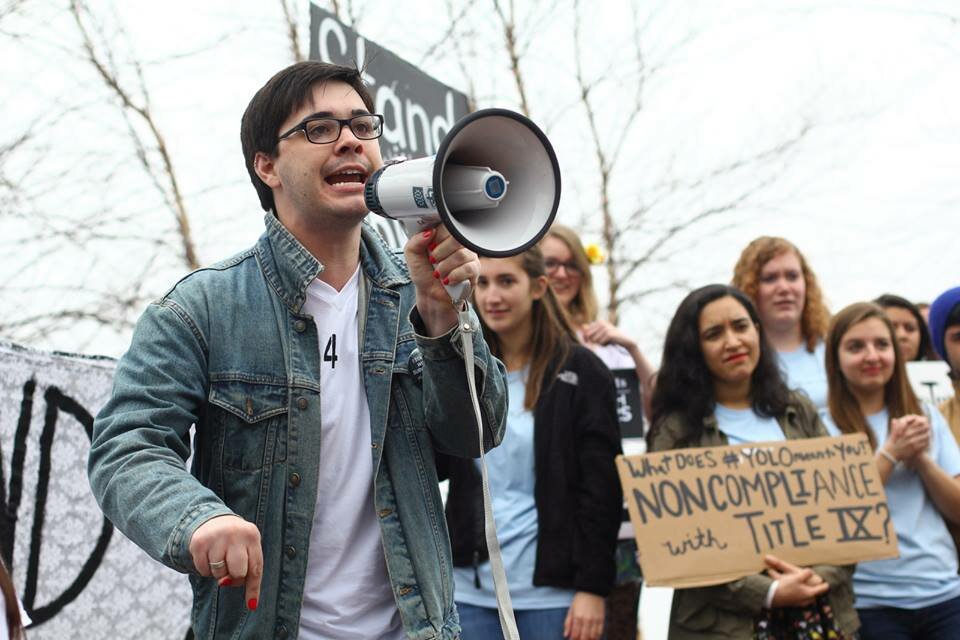
John Kelly is a male, queer sexual assault survivor and student anti-rape activist, affiliated with Know Your IX and ED Act Now. He is a rising senior at Tufts University and in April 2014 he and other students led a rally against the administration’s decision to reject Title IX compliance.
1) When did you first become in sexual violence prevention activism? How?
I first became involved in this activism after experiencing intimate partner violence and rape while a college freshman and sophomore, almost two years ago. I reported my assailant, and had to go through my university’s sexual misconduct adjudication process, where I was humiliated and traumatized left and right. I didn’t know much about the law back then, but I knew what happened to me was unacceptable, and I wanted to do everything I could to prevent it from happening again. I started working with student groups on campus on the policy, and before long ED ACT NOW’s founders were reaching out to me to join their campaign, and everything just took off from there. Since then, I’ve continued working with ED ACT NOW and our umbrella organization Know Your IX, and through that was a student negotiator on the Violence Against Women Act Reauthorization negotiated rulemaking committee through the Department of Education, presented policy recommendations to the White House Task Force, and [on June 2nd, 2014, I participated] in a roundtable discussion with Senator McCaskill on campus sexual assault.
2) Before enrolling in college did you give any thought to the issue of campus sexual assault? Why or why not?
I didn’t give it a single thought. I didn’t think it happened to men—it wasn’t an issue that would affect me, so why would I care? Looking back, I can’t believe how wrong I was. While I hadn’t yet come to terms with my identity as a queer male, the fact of the matter is sexual violence affects all populations, and now that I have some distance from my trauma, it’s scary to think I hadn’t realized just how pervasive it is before it happened to me. Even after coming to terms with my identity, I didn’t know that sexual violence could affect me, or my friends, or future partners.
3) How long was the process for you and other students to file Title IX/Clery complaints with the Department of Education against Tufts? What were some of the challenges you faced during the filing process?
I actually haven’t been involved in filing Title IX or Clery complaints against Tufts yet. During this most recent Title IX investigation I was interviewed by the Office of Civil Rights and testified to the issues I faced in reporting, and many of my complaints made it into the OCR’s resolution agreement and finding against Tufts, although I doubt that I was the only student interviewed who had such experiences.
4) When you learned that Tufts would be asked by the federal government to go under voluntary compliance for their Title IX violations, what was your reaction?
I was beyond thankful. We—student survivors and activists on campus, including myself—have been telling Tufts administrators for months that our policy and resources were not up to snuff. After seeing the harm that they caused me, and to then see survivors going through the process currently be facing the same exact issues—issues that also faced people years before I came to Tufts—I knew something had to change. Through Know Your IX, I’ve worked with Catherine Lhamon, Assistant Secretary of Education for Civil Rights, and have been really impressed by her willingness to do things her own way, and I was just so happy to see that is going to include actually finding schools out of compliance with Title IX.
5) When you learned that Tufts issued a statement that they would not continue with voluntary compliance for Title IX violations, what was your reaction? How did other students on campus react?
This was a move that came way out of left field. From a legal standpoint, you can’t just revoke a signature from a binding legal document, which is what Tufts did, and I am pretty confused that any attorney would think that was a good idea. Tufts has been trying to paint their decision as an act of “active citizenship”, but we all saw right through it. It was a petty move by petty administrators to attempt to cover up their continued wrongdoing, and instead came out looking like a group of disconnected people with no understanding of the plight of survivors on campus. Honestly, it was an absurd and humiliating decision—it showed just how removed Tufts’ administration is from the actual student experience.
6) What organizing strategies did you and other students use to protest/raise awareness about Tuft’s decision to forgo voluntary compliance with Title IX? Do you feel they were effective?
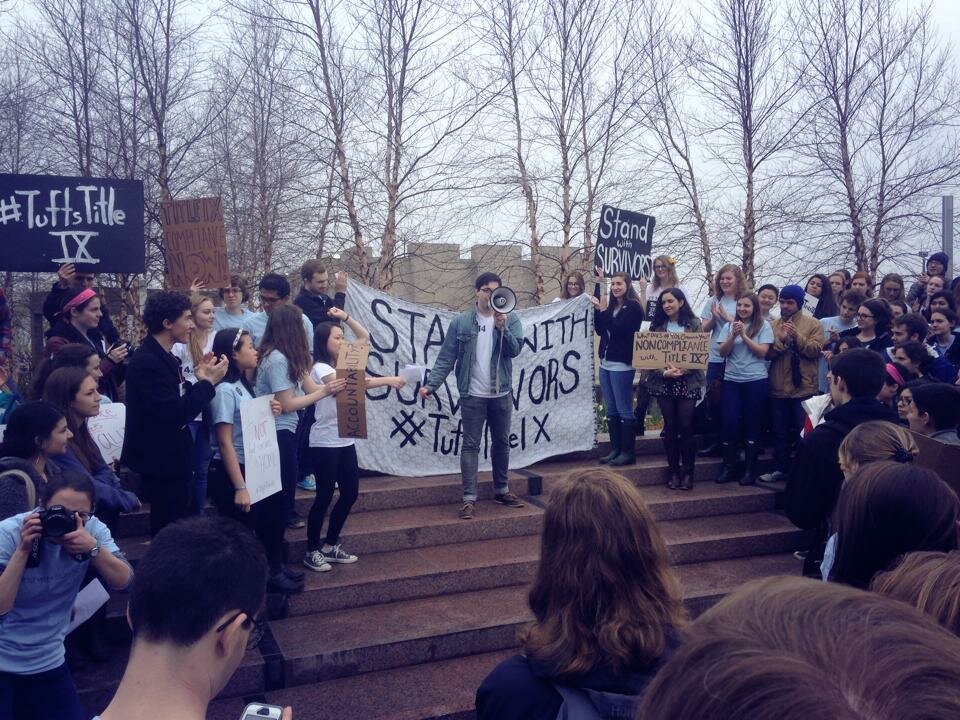
Within minutes of the email our president sent around, students were in communication about this. A group of us—activists, people involved in student groups related to this issue, survivors, and others—knew that something needed to happen. We made the decision within a few hours that we needed to stage a protest, and worked on ways to make that a reality. So many students stepped up big time, during the middle of exam week, to make it a success. We launched a petition that gathered over 1,500 signatures, profile pictures on Facebook that were used by students from every corner of campus, posters that were up the next day, and had the largest rally at Tufts since the 1980s. Students were talking about it, students were upset, and students got educated. I think that it was a highly effective and quick campaign that we launched, and we hope that the dialogue will continue into the next school year.
7) Did you feel Tufts was open to hearing student concerns about incidents of campus sexual violence and administrative misconduct towards survivors? Why or why not?
In some ways, yes, and in others not at all. I worked with administrators to make our policy more explicitly inclusive of same-sex violence, and they were incredibly receptive to that, and students have been involved in a task force on campus, myself included. However, the fact of the matter is if the administration were listening fully to students we would be further along by now. While the administration has made a number of very necessary improvements within the past year and listened to students in those decisions, when it comes to the tough choices, Tufts has not been listening to us. When it comes to removing problematic administrators, taking a harder line on punishments, or speeding up adjudication processes, Tufts hasn’t listened.
8) When you went into the negotiating room with Vice President Harris and other members of the administration, what was it like? Were the negotiations friendly, hostile or neutral? Do you think administrators truly heard the concerns of student activists and survivors during the negotiation process? Why or why not?
Again, I think there was a range. Some administrators were very engaged and ready to get important work done, others not so much. President Monaco rearranged a lot of his schedule while on the West Coast to participate, which we definitely took notice of and appreciated. However, when we suggested that Tufts issue an apology for the harm they caused to survivors by attempting to revoke their signature, they flat out said no. To make matters worse, the reason they used was because they “didn’t mean to hurt anyone.” Speaking to a room of survivors and activists, I think we all know that intention only gets us so far. That’s a rape apologist defense if there ever was one. I very much got the sense from some administrators that they believed we were overreacting—the typical angry victim narrative. However, it’s hard not to listen when you have hundreds of students forming a human chain three rows deep around an entire building, chanting “Re-sign or Resign” at the top of their lungs.
9) What do you think is the future for Tufts in regards to campus sexual violence? Do you think the administration will make a concerted effort to combat violence and support survivors? Or do you believe they are more concerned with “compliance” to Title IX and Clery to avoid future allegations?
I think that over the course of this year, the student body has really mobilized around this issue. We ran an event in early April, It Happens Here, that filled our largest auditorium on campus, we launched the task force in September, and then the protest in May. The unfortunate reality which is by no means limited to Tufts is that schools tend to be reactionary in what they do—they wait until something goes very wrong to change anything, and then they change the bare minimum. I’m worried because the move of Tufts to revoke their signature to me indicates an inability to listen to anyone, even the federal government, which may not bode well for students in the future. However, I think in some ways things will improve, because Tufts has seen the full brunt of student outrage on this issue, and knows that it won’t go away very easily. They have a lot to do to appease us, and I think that gives us a stronger position than we’ve had previously.
10) What would you tell students who are considering taking action against their administration for non-compliance with Title IX/Clery, misconduct towards survivors, or to push them towards adopting a stronger policy on sexual violence?
Don’t let anyone bully you out of doing what you know to be right. If comfortable (and that comfort is a privilege), use the bully pulpit to your advantage. I think what the wave of student activism across the country has taught us is that schools respond when their reputations are threatened, which can only be done through public shaming. Schools didn’t respond until survivors were coming forward—look at Harvard recently, or Amherst last year, or so many other schools. While public shaming can’t solve everything, and may lead to an antagonistic relationship with administrators, it can go a long way in making a school take the need for stronger policies seriously.
11) Anything I missed that you think would be helpful for survivors?
Don’t forget to breathe.
SAFER would like to thank John for participating in this interview and for his continued commitment to combatting campus sexual violence. All responses published here are John’s own and are not necessarily reflective of SAFER’s opinions.